
Artesia Holding Release Paths
The Artesia Police Department operates a temporary holding and processing facility inside the Public Safety Complex. The official description identifies two local functions: holding arrestees while they await an initial appearance and holding some people who serve municipal-court sentences. That limited role makes a disappearance from the Artesia setting ambiguous. One person may have been released directly after court action or after a municipal sentence. Another may have been taken to Eddy County Detention Center because the arrest involved a felony or a magistrate ordered continued custody.
These outcomes must not be merged. A direct release ends the municipal holding episode and calls for APD or Artesia Municipal Court documentation. A transfer to Carlsbad leaves the person in custody and creates an ECDC booking trail. The absence of a name from one local facility cannot prove community release. Identify the court level, charge path, and next custodian before stating what happened.
| Artesia outcome | Best verification source |
|---|---|
| Direct release after initial appearance | APD record and the signed municipal or magistrate court order |
| Municipal sentence completed | Artesia Municipal Court case and APD custody record |
| Felony or continued custody | ECDC portal, release record, and district or magistrate case |
| Later state transfer | ECDC movement record followed by NMCD offender search |
Verify an Artesia Release
Start with the official Artesia detention description. It establishes the holding facility’s scope and the county-jail transfer rule. No APD portal dedicated to historical released-person results was located. The practical search therefore branches based on whether the person left Artesia custody for the community or for ECDC.
- Match the full name and approximate arrest date, then determine whether the matter was municipal, magistrate, or felony.
- Ask APD for the custody record when a short municipal stay may have ended in Artesia.
- Search the relevant court case for the initial-appearance result, release conditions, municipal sentence, or continued-detention order.
- Search the Eddy Zuercher portal if the person was sent to ECDC in Carlsbad.
- Request the source record from the correct custodian when a search result lacks the time, authority, or destination.
The court summary and police custody record serve different roles. A court entry can show a release order, disposition, sentence event, or conditions. APD’s record should document its own holding episode. If ECDC received the person, its booking and release fields control the county detention episode. The Eddy County released inmate lookup supplies the wider path when the person later moved into state, federal, or immigration custody.
Artesia Holding Records Contact
The holding facility is inside police headquarters at the Artesia Public Safety Complex. Research did not locate published detention release hours, a release entrance, property-return rules, waiting instructions, or a separate detention-records telephone. Use the official city detention page as the starting point and ask APD for the office that keeps the booking, holding, and direct-release entry for the named person.
Artesia Police Department Holding FacilityPublic Safety Complex
3300 W. Main Street
Artesia, NM
Temporary holding, initial appearances, and some municipal sentences
When the person was transported to ECDC, contact the county jail at 575-887-7556 and use its public portal. A county record request can specify the ECDC booking number, arrest date, release date, held-for agency, release basis, and destination. That county route should not replace an APD request for someone directly released from municipal custody, since the person may never have had an ECDC booking for that event.
Note: Ask which office created the record before filing, because APD, ECDC, and the court each control different facts.
Artesia Court Release Records
Artesia’s court structure explains why one search may not tell the whole story. Artesia Municipal Court handles ordinance matters. Artesia Magistrate Court handles misdemeanors and the early stages of felony cases. Felony cases then proceed in Eddy County District Court in Carlsbad. The durable order may therefore sit in a different court from the police facility that first held the person.
Use New Mexico Case Lookup for public district and magistrate summaries and the limited municipal history it provides. A result may show the case number, party, charge, disposition, sentence event, and register of actions. General public access does not display the filed documents. Ask the filing court for the signed release, dismissal, detention, judgment, or sentence order when the summary cannot establish the authority.
- Initial appearance
- The first court proceeding where custody and release conditions may be addressed.
- Direct release
- Departure from APD holding without an intervening ECDC transfer.
- Remand
- A court direction that a person remain in or return to custody.
- Transfer
- Movement to another custodian while custody continues.
A court order date and physical release time can differ. Label each one. If the court summary shows release but ECDC lists an active booking, check whether a second case, warrant, held-for agency, or processing delay explains the conflict.
Artesia Holding Facility Record
The city’s official detention page is the successful manifest source for this location. It documents temporary holding and the ECDC transfer distinction.
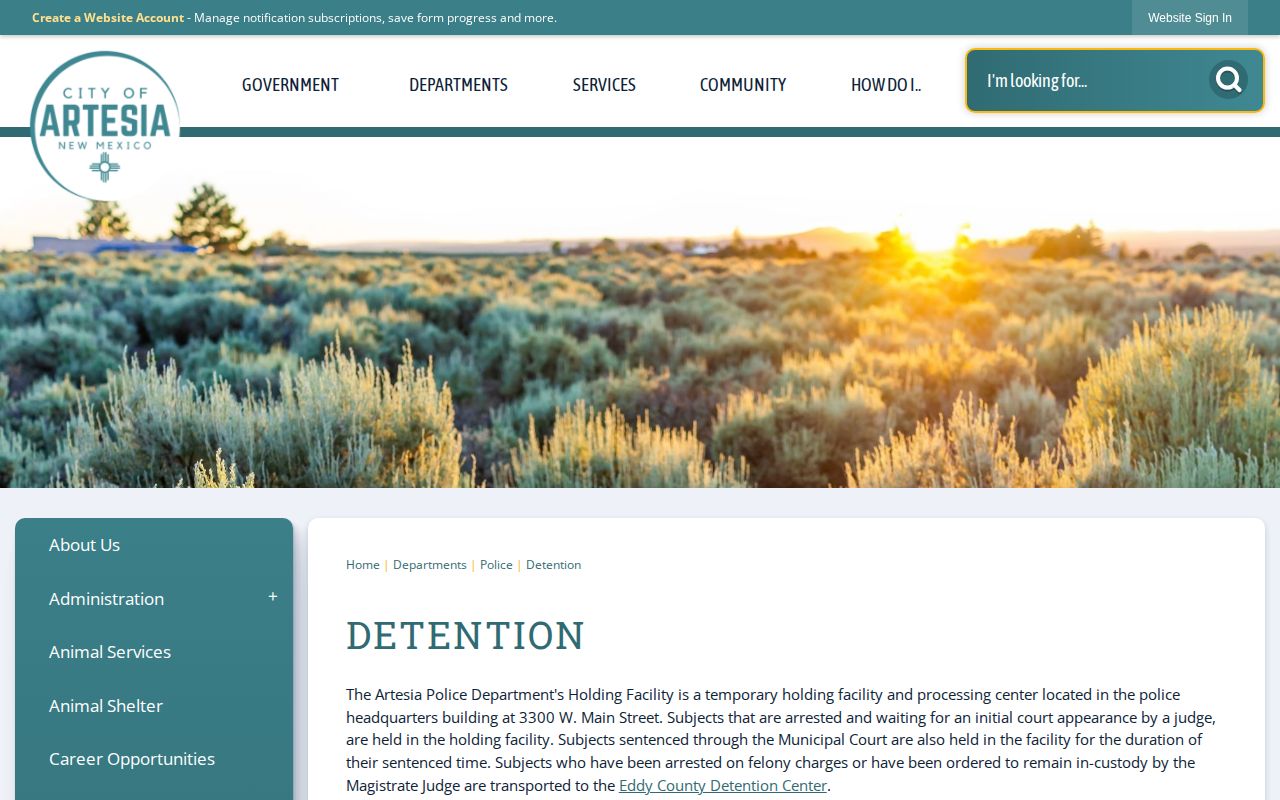
The city description supports a two-route search instead of treating APD holding as a smaller version of the county jail.
No separate historical release feed, posted cadence, or release-date search for this municipal facility was found. That is a bounded research result, not a claim that no record exists. Public records can still be requested from the office that created them, and the related court case may preserve the legal event after a short holding entry is no longer visible.
Artesia Transfer to ECDC
A felony arrest or continued-custody order shifts the search to the county jail. Open the Eddy Zuercher portal and search by name. If the booking has ended, use a prior “In Custody On” date, arrest-date range, or release-date range. Note the arrest date, release date, and held-for agency. Because the portal omits charge information and a full release reason, reconcile its entry with the magistrate or district case.
Later disappearance from ECDC can be another transfer. An NMCD, ICE, Marshals, ASU, or other-county category points to the next system. NMCD covers state prisoners and people on NMCD supervision, not city or county bookings. ICE’s locator is limited to current detainees and recent releases in its stated window. The Marshals Service has no public historical release locator. Each source answers only for its own custody.
The minimum sound confirmation pairs a custodian-specific closing entry with a record that explains authority or destination. For example, use an APD direct-release entry plus the municipal order, or an ECDC release timestamp plus a bond order. One negative roster result is not enough.
Note: Record the exact agency, case, and date so two separate custody episodes are not mistaken for one release.
Request Artesia Release Records
Keep a request focused. Give the person’s full name, aliases, birth date if known, the approximate arrest or holding dates, and the municipal or court case number. Ask for the APD holding entry, admission and release times, the release authority, transfer time and destination if applicable, and the record that identifies who received custody. A narrow request helps the custodian distinguish a direct release from a trip to ECDC.
If the event became an ECDC booking, use the county NextRequest form for county-created records. Its optional date-range and case-number fields support a specific request. For a signed court document, contact the filing court rather than asking APD or ECDC to reproduce the court’s official file. Courts do not maintain the police booking file, while police do not control the court’s judgment.
New Mexico public access is governed by the Inspection of Public Records Act, subject to exemptions and court restrictions. Juvenile, sealed, expunged, medical, and security-sensitive material requires care. When part of a record is withheld, the custodian should address the basis under applicable law. An expunged booking may be removed from general public access, so a later missing entry does not prove that no custody event occurred.